


DHS starts deportation flights after end to remaining protections for TPS holders
DHS starts deportation flights after end to remaining protections for TPS holders

Rebecca BeitschSat, August 22, 2026 at 10:00 AM UTC
51
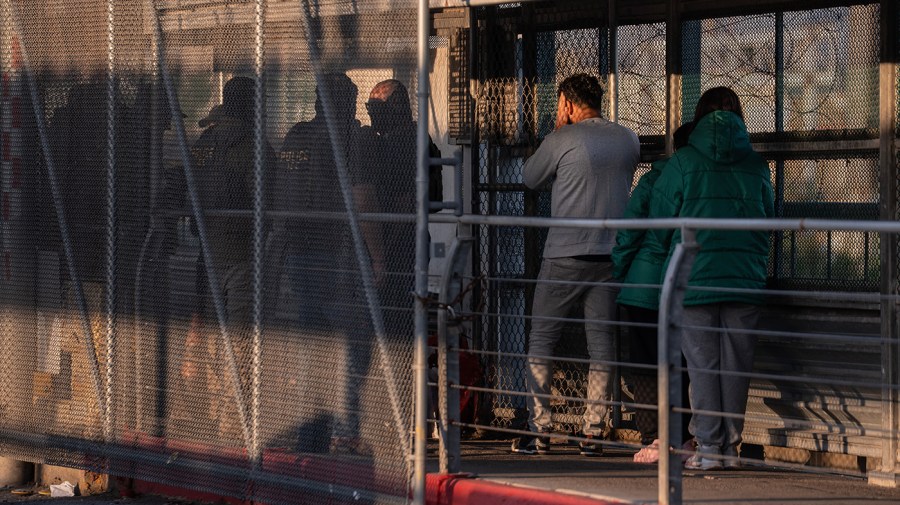
Lower court judges have now fully lifted certain limitations on the Department of Homeland Security (DHS) in the wake of a Supreme Court decision that cleared the end of temporary protected status (TPS), removing any final roadblock to deportations.
A federal judge earlier this week lifted the final stay that barred immigration officials from carrying out deportations to Ethiopia. That was the last of various court cases by TPS recipients challenging the termination of their protections.
Immigration officials are now free to deport nationals from 13 countries that prior administrations determined were not sufficiently stable because of natural disaster or civil unrest to safely return migrants.
The additional four countries that still retain their TPS designation are set to expire shortly, meaning more than 1.3 million protectees either have or are likely to soon lose their legal status.
“Effectively, this signals the end of the program,” Nayna Gupta, policy director at the American Immigration Council, told The Hill.
“This an unprecedented delegalization campaign. It's the largest effort to strip people of lawful status in U.S. history.”
The Supreme Court in its June ruling didn’t end the TPS program but determined the courts did not have the power to review the administration’s decision to end protections for citizens of Haiti and Syria — two countries marred by violence.
While that left very narrow grounds to continue litigation, the ruling has real-life impact now.
Guerline Jozef, executive director of the Haitian Bridge Alliance, a nonprofit advocacy group that also provides legal services to TPS holders, shared the story of one Haitian woman who fled to the U.S. at age 19.
“For the first time when she got to the United States, she woke up and was not worried about being kidnapped by armed groups in Haiti. For the first time, she wasn't worried about seeing a dead body on the street of where she lived. For the first time, she went to bed not hearing gunshots,” Jozef said.
“After the termination of TPS, when she saw an ICE car for the first time she felt so unsafe again, fearful that she would be taken by ICE, so the same fear that she had about being kidnapped by armed groups in Haiti came back in the form of being kidnapped by ICE," she said, using an abbreviation for Immigration and Customs Enforcement.
Beyond Haiti and Syria, TPS holders from Venezuela, Nicaragua, Honduras, Afghanistan, Cameroon, Nepal, South Sudan, Burma, Ethiopia, Yemen and Somalia can now be deported.
Lower courts had blocked DHS from carrying out deportations, but those rulings had to be reexamined in the wake of the high court’s ruling, even though many judges had initially sided with TPS holders in temporarily blocking deportations.
James Percival, the top attorney at DHS, celebrated when the final stay was lifted by a lower court judge based in Massachusetts.
“Judge Brian Murphy just lifted the stay of Ethiopia TPS termination. All TPS terminations are in effect!” he wrote Tuesday on the social platform X, sharing a graphic modeled after one used by Facebook that allows users to mark themselves as safe after an event, with the attorney writing he was now safe “from TPS judges today.”
Haitians are among the largest groups of TPS holders, with nearly 350,000 protected under the status prior to the Supreme Court ruling.
Many are now contemplating what to do next as their once-legal status evaporates.
“It's been an incredibly difficult, painful time,” said Jozef, who added that it comes after “a difficult day, week, month, and year.”
On Thursday night, the Trump administration conducted its first deportation flight to Haiti since the end of TPS, a plane Jozef said carried roughly 170 people, including one of her clients.
Many TPS holders are now being pressured to return to countries where the State Department has actively highlighted the dangers on the ground.
That’s particularly true for Haiti and Syria.
Advertisement
The Caribbean nation has been dominated by gang violence in the wake of an assassination of their prime minister in 2021 that has left the country with a transitional government.
House Foreign Affairs Committee Chair Brian Mast (R-Fla.) visited Haiti earlier this summer as part of a congressional delegation, describing the country as having areas “like Afghanistan” — where he was deployed while in the military — and adding “it is probably the poorest place I've ever been through in my life."
In Syria, warring factions are still feuding across the country after ousting leader Bashar Assad, who deployed chemical weapons against his own people.
The State Department has rated each a “Level 4 Do Not Travel” country.
The Haiti deportation flight carried out Thursday night landed in the northern coastal city of Cap-Haitien, as the U.S. bars commercial flights into Port-au-Prince — where gang members who largely control the capital city routinely fire at landing planes.
Jozef noted a high-ranking military leader, charged with protecting the public, was ironically kidnapped earlier this summer by gangs.
“If the department that is in charge of protecting the people, they themselves have been kidnapped, how will they be able to protect people being deported to Haiti right now?” she asked.
“Even the Department of Defense is unable to defend themselves against the armed groups in Haiti right now.”
Many judges made it clear the Supreme Court had tied their hands after they issued rulings backing TPS holders on a number of grounds, including that the Trump administration had acted with racial animus in terminating the protections.
Massachusetts-based U.S. District Judge Allison Burroughs wrote an emotional order last week lifting her earlier block on deporting citizens of Somalia.
“Plaintiffs have made a convincing showing that they will suffer irreparable harm if the injunction is withheld … and the balance of hardships and the public interest also favor Plaintiffs, given that the government has made no showing that maintaining TPS status for the duration of this litigation would impose an undue burden,” she wrote.
Also frightening for TPS holders is they have little control over where they may be deported. While some might be returned to their home countries, TPS holders could be sent to a third country if their home nation doesn’t accept flights. Eswatini and Liberia are among those that have agreed to accept deportees.
Jozef noted that many times, those sent to third countries are often placed in “confinement” in a prisonlike setting.
“The deportations are costing U.S. taxpayers money — it is not free,” she said, noting that the U.S. has agreed to pay other countries millions to accept deportees.
And though not a TPS holder, one deportee sent to Haiti was from the Dominican Republic, according to The .
Thursday night’s deportation flight, while not the first to Haiti, represents the beginning of an expected uptick in such removals, particularly for TPS holders.
Gupta noted that plan is not without challenges in countries like Haiti, “where conditions are so horrific on the ground that it's difficult for airplanes to land in the country," meaning the Trump administration "is likely facing greater logistical barriers on that front.”
Jozef noted that many TPS holders, particularly from countries that have been more recently designated, have few options for attaining some other form of legal status. Many do not have U.S. citizen children who have reached age 21, where they would be able to sponsor them to adjust their status.
“There are a lot of people who have applied for asylum. Unfortunately, 90 percent of those cases have been denied,” she said.
Gupta and other immigration advocates have for years advocated for TPS holders to be able to obtain a permanent path to citizenship, but like many immigration efforts in Congress, those pushes have stalled.
“While it is absolutely shocking because it violates American norms,” she said of the TPS deportations, “it's unsurprising in that we knew this was always a risk, and that these were folks who are always vulnerable, given their liminal status, which inherently means not having a permanent place here in the United States.”
Copyright 2026 Nexstar Media, Inc. All rights reserved. This material may not be published, broadcast, rewritten, or redistributed.For the latest news, weather, sports, and streaming video, head to The Hill.
Source: “AOL Breaking”
